Exterior house paint color visualizer: build a body, trim and door combo
Choose the main color for your siding. The tool suggests trim and front door colors, explains why, checks light/dark contrast and warm/cool balance, and shows the closest AI sample-home photo. Then try your exact combo on a photo of your own house in the iPhone app.
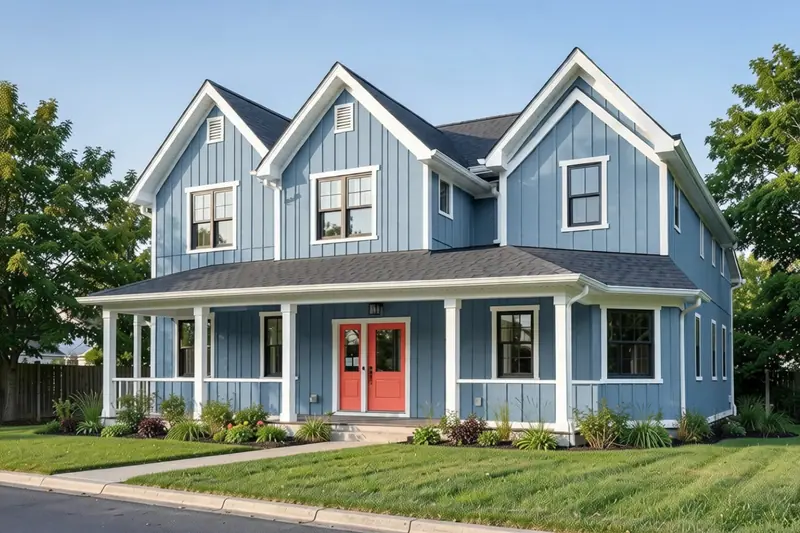
Closest sample-home photo: Modern farmhouse in Coastal Blue, Bright Snow trim and a Coral door
This photo matches your combo.
1. Pick your body (siding) color
2. Suggested trim colors
3. Suggested front door colors
Contrast & harmony check
How the suggestions work
The tool ranks trim colors by light/dark (value) contrast with your body color and by warm/cool balance, and suggests door colors from a complementary accent to a wood tone. There is no magic formula for exterior colors, but these rules explain why some combinations look finished and others look flat. It does not use AI and it does not know your neighborhood, so treat its picks as a starting point. Your choices stay in your browser; the privacy policy explains what the site measures.
1. Light/dark (value) contrast does most of the work
From across the street you notice value (how light or dark a color is) before you notice hue. Trim that is much lighter or darker than the body outlines the windows, roofline and corners. Trim close in value to the body blends in, which can look calm and modern or simply washed out. The contrast number shown is the WCAG luminance ratio between body and trim: around 1–2 : 1 blends in, 3 : 1 and up reads clearly.
2. Keep warm and cool in balance
Colors lean warm (toward yellow, red or brown) or cool (toward blue, green or grey). When body and trim share a temperature, or one is a true neutral, the scheme tends to feel harmonious. A front door with the opposite temperature is a classic way to add energy without fighting the body. Sage green with cream trim is an example: cream shares the warm undertone of sage.
3. Give the door a job
The door is the smallest surface and the easiest to repaint, so it is the best place for a stronger color. The tool offers a complementary accent, a deeper shade of the body, a wood tone, a classic dark door and a saturated statement color. For a neutral body, see these front door colors for a warm gray house.
4. Respect what you can't paint
Your roof, brick, stone, windows and gutters stay. Pick the roof that is on your house (or the one you plan), and check that body and trim still work next to it. Warm brown roofs suit warm bodies; charcoal and black roofs go with almost anything.
5. Test outdoors before you buy
Screens are not paint. Paint large samples (at least 2 by 2 feet) on two sides of the house and look at them in morning and late-afternoon light. Colors usually look lighter and brighter outdoors than on a chip.
Want to see it on your home? The Exterior Paint Visualizer app for iPhone and iPad paints a photo of your own house, and the color ideas show proven schemes on photos of six house styles.